




Analog Devices Inc. MAX31825 1-Wire® Temperature Sensor
Analog Devices Inc. MAX31825 1-Wire® Temperature Sensor provides 8-bit to 12-bit Celsius temperature measurements with better than ±1°C accuracy from 0°C to +70°C and ±1.75°C from -45°C to +145°C. The MAX31825 sensor communicates over a 1-wire bus that, by definition, requires only one data line (and ground) for communication with a microcontroller. In addition, the sensor can derive power directly from the data line (parasite power), eliminating the need for an external power supply.
Each individual MAX31825 sensor has a unique 64-bit serial code, which allows multiple MAX31825 ICs to reside on the same 1-wire bus. In addition, this device includes two address input pins that, using an external resistor and pin-strapping, allow one of 64x different addresses to be selected to identify each sensor's physical location. Therefore, it is simple to use one microprocessor to control multiple devices distributed over a large area.
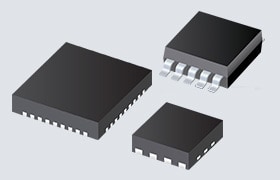
The Analog Devices MAX31825 is available in a 6-bump WLP package. The power supply voltage range is from 1.6V to 3.6V for external power supplies, and from 2.3V to 3.6V for parasite power. The operating temperature ranges from -45°C to +145°C.
Features
- 1-Wire interface requires only one port pin for communication
- Unique 64-bit serial code stored in an onboard ROM
- External resistor selects an address for location identification
- Can be powered from the data line
- Power supply range
- 1.6V to 3.6V external power
- 2.3V to 3.6V parasite power
- Measures temperatures from -45°C to +145°C
- Better than ±1°C accuracy from 0°C to +70°C
- Better than ±1.75°C accuracy from -45°C to +145°C
- Alarm output for detection of temperature faults
- Temperature resolution is selectable from 8- to 12-bits
- Converts temperature to 10-bit digital word in 80ms (maximum)
- User-definable alarm settings
- 4kV HBM ESD protection
- WLP-6 package
Applications
- Communications equipment
- Consumer equipment
- Data center equipment
- Industrial equipment
Videos
Block Diagram

Typical Application Circuit

Development Tools

Analog Devices Inc. MAX31825EVSYS1 Evaluation System
Demonstration and development platform for the MAX31825 1-Wire® Temperature Sensor.