




Murata Noise Problems/Noise Suppression in the 5GHz Band
Wireless LAN capabilities are continually being added to growing numbers of smartphones and other digital devices. In certain regions, technology using the 5GHz band for LTE communication (LAA/LTE-U) was adopted for enabling higher speeds for data communication. And because wireless communication in the 5GHz band is expected to keep growing, Murata researched noise problems that occur in communication using the 5GHz band and developed several solutions.
Timeline

Wireless communication in the 5GHz band
Murata examined the case for noise issues that occur when high-speed data communication is performed indoors using a wired interface as well as the case for noise issues that occur in environments with multiple wireless communications.
Higher drive frequencies are being supported by individual electronic devices indoors, and there are concerns about the occurrence of noise at high frequencies. There also have been cases where the wireless LAN 5GHz band and the LTE 5GHz band are used simultaneously.
These are some of the expected issues that occur when this happens:
• Issue where it is difficult to connect to the wireless LAN when devices are connected to one another
• Issue where downloads become slower when multiple communication systems are being used
Murata examined some specific cases where noise occurs.
Noise Occurrences

Noise & multiple wireless communications
Introduction of LAA/LTE-U
First, Murata presents the case for multiple wireless communications. Although Murata is quite familiar with Wi-Fi® for wireless communication using the 5GHz band, utilization of the 5GHz band has also been determined for the LTE system, which is used in smartphones. LTE using the 5GHz band is called LAA or LTE-U, and it is a technology that enables high-volume communication through existing LTE and carrier aggregation. When this is performed, simultaneous use with Wi-Fi is also expected, meaning the circuits for the three systems of LTE, LAA, Wi-Fi are all running. Murata looks at whether wireless communication can be performed without any problems in this situation.
Case of LAA communication

Specifications

Reception sensitivity & multiple communications
The reception sensitivity diagram (Figure 1, below) shows the measurement results for LAA reception sensitivity when LAA communication is started while Wi-Fi communication is already running. Murata determined the reception sensitivity was reduced when Wi-Fi communication was turned on.
When the reception sensitivity is reduced (Figure 2, below), if the signal strength from the base station or access point is weak, communication cannot be performed properly. This means the data rate will be slowed, which could be stressful for some users. This issue occurs because Wi-Fi and LAA are communicating using the same frequency, and this is due to the effect of noise generated when signals in the 5GHz band interfere with each other or the wireless circuits are running. Previously, there were no wireless circuits at the same frequency that were running simultaneously.
Figure 1
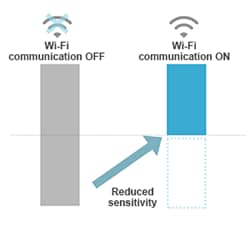
Figure 2

Causes for reduced reception sensitivity
To confirm the causes of reduced reception sensitivity, Murata conducted an examination using a system simulation. In this simulation, the communication characteristics are obtained for an environment where no noise occurs because each block is operating in the ideal state.
The results show, while reception sensitivity was reduced in actual devices, this change was not observed in the simulation. This indicates the reduction in reception sensitivity does not occur simply because of simultaneous communication by LAA and Wi-Fi. Murata speculated the cause to be noise that occurs when each circuit is running, so Murata conducted a noise study on the interior of an actual device.
Case of LAA communication

Figure 3

Noise occurring during LTE, LAA, and Wi-Fi communication
Conductive noise measurement results on power lines
The schematic diagram (Figure 3, above) shows the LTE, LAA, and Wi-Fi circuit blocks. Measurements were conducted on the noise of the power line when communication was performed under the conditions shown on the right side. The results show the power line of the Wi-Fi module has the highest level on the spectrum, and the same spectrum was observed for the power line of the RFIC. This matches the bandwidth of the Wi-Fi communication signal, suggesting noise originating from Wi-Fi is transmitted to the power line and is flowing into the circuit blocks.
Murata summarizes the points about noise generation and the conductive path:
• The noise that was verified in the power line of the RF circuits has a bandwidth of 80MHz.
• Communication is performed at a bandwidth of 80MHz for the Wi-Fi signals and at a bandwidth of 20MHz for LTE and LAA.
• From the above points, the noise is flowing out from the Wi-Fi module and into the power line.
• Noise flows into the RF circuits, which reduces the signal-to-noise ratio (S/N) of the receiving LNA.
• Ultimately, this reduces the reception sensitivity.
Noise Suppression Filter
Because Murata discovered the noise generation and conductive path, it inserted a noise filter to reduce the noise conduction. The noise filter was inserted in the power input unit of the RF circuits.
Filter insertion location

Noise suppression Method & Improvement Results
The Murata BLF03VK series for noise reduction in the 5GHz band was used for the noise filter. Murata confirms reception sensitivity is improved when the conductive noise is reduced.
In environments using multiple wireless systems where the frequencies overlap, noise can be conducted from one communication circuit to another and adversely affect it. An effective countermeasure is to put a noise removal filter, capable of removing the specific frequency band, into the power line.
Improvement Results Chart

Noise & high-speed differential data communication
Issues When Performing HDMI Communication
Murata also presented issues that occur when performing HDMI communication in a home environment. HDMI is widely used as a video system interface for connecting BD recorders, STBs, and TVs. It is also used as a stick PC interface for converting TVs into PCs. In the latest standard, HDMI version 2.1 was announced, but many users are probably using 2.0 or 1.4.
The table (Figure 4, below) shows the results when a stick PC was inserted into a TV, and the Wi-Fi reception sensitivity was measured during HDMI communication. As shown in the table, the sensitivity was reduced by slightly less than 4dB, and noise occured in conjunction with the HDMI circuit operation, which results in reduced reception sensitivity.
HDMI Communication Diagram

Figure 3

Wi-Fi reception sensitivity table during HDMI communication
Study of Signals During HDMI Communication
The next question: What is happening during HDMI communication? Murata investigated the signal state.
This stick PC diagram (Figure 5, below) shows a mapping of the magnetic field distribution for the PCB surface of the stick PC mentioned earlier. It consists of an HDMI connector, wireless circuit, and control IC. Because it is packed into a size of about 15cm x 8cm, all circuits are in close proximity.
As a result, if noise occurs inside the device, it is coupled to the antenna and other RF circuits and easily disturbs wireless communication. In this stick PC, it appears that noise is distributed over the entire PCB, so Murata affixed an electromagnetic wave-absorbing sheet to the entire PCB and verified whether the level of noise coupled to the antenna had changed.
The noise level dropped by about 10dB, indicating the noise was coupled from the PCB to the antenna.
Figure 5
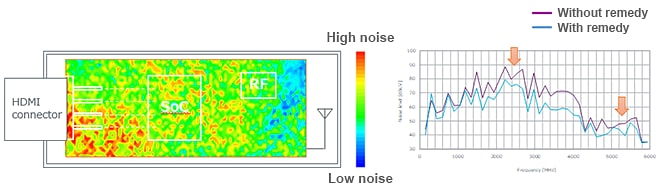
Possible Effective Remedies
When Murata speculated noise was generated when HDMI was running, it also reasoned noise was being conducted in the signal line.
Murata decided to try using noise reduction filters for the HDMI signal and clock lines. Two types of filters were used -- common-mode choke coil and Pi low pass filter (LPF). A common mode choke coil is a filter that is effective for removing common-mode noise only, without affecting the signal waveform of the differential transmission line.
Although no effect was observed using the common mode choke coil, the Pi LPF was effective at reducing noise. This indicates differential mode noise is being conducted in the stick PC. (Note: The common-mode noise component may be dominant for some target devices, so a common mode choke coil may be effective in some cases.)
Effectiveness Remedies Chart

Selection of Filters
Because the differential mode noise was dominant, Murata had to select a filter that would reduce noise but not affect the signal.
So Murata developed a new BLF03VK product series that provides effective noise reduction in the 5GHz band. Murata selected an item with these characteristics from this product series.
Ferrite Beads for 5GHz Band
Features: Instead of the impedance increasing from low frequencies like conventional ferrite beads, the material and internal structure have been designed so the impedance increases at 5GHz.
The selection filter overview (Figure 6, below) examines the filter for the 5GHz band only, but Murata's product lineup also includes filters for 2.4GHz and 700MHz bands.
Figure 6

Effects of Remedies Using Noise Filters
The diagram (Figure 7, below) shows the results when the Pi filter was replaced by the BLF03VK, and the noise reduction effects were verified. It was confirmed that the high-frequency component of the clock was reduced by about 10dB.
The area filled in with yellow indicates the channels used by Wi-Fi (11ac), and noise can be seen in channels 36 and 124. This resulted in a particularly large reduction in reception sensitivity in channels where noise occurred. But by applying noise suppression using the new noise filter, the narrow-band noise originating from the HDMI clock was reduced for enabling higher reception sensitivity.
Figure 7

Check of Signal Quality
Because the filter was inserted in the HDMI data and clock lines, the signal quality was checked. (Figure 8, below)
HDMI 1.4 Signal Waveform
The results for the HDMI 1.4 pre-compliance test that was conducted show the test was passed without hitting the eye mask, even when a filter was used. This is partly due to the small impedance in the low-frequency band by the BLF03VK series. The need is expected to grow for filters in which the impedance increases only in the specific bands and where noise will be removed for ensuring signal quality. (Note: The waveform when the filter is actually used will vary depending on the IC and set environment, and so verification is necessary.)
Figure 8

Summary
Murata presented two examples of remedies for reducing the noise in the 5GHz band.
Previously, the 5GHz frequency was not commonly used, so users might have thought noise issues were unlikely to occur. But when Murata actually examined the noise, it found that noise was occurring in both the signal and power systems.
Even if the 5GHz band is selected for providing stable, high-speed communication, maximum performance cannot be attained if noise is present. Murata's noise suppression products can be used to create a low-noise environment, ensuring stable communication quality.
Summary Chart

SimSurfing Tool

Murata SimSurfing Tool
A free website design tool that provides information and data for selecting electronic components.
Community Forum
Murata Community Forum provides searchable content with various discussion topics, popular blogs, and articles. The Murata broad market support team holds regular reviews to discuss open issues, allowing inquiries to be answered in a timely manner. The forum content is freely accessible to the public. However, users must log in to post questions or answers. Registration is free of charge.
Learn More

Murata EMI Noise Suppression
Provides engineers with complete support, including products & design-simulation software solutions.
Related Products

Murata Electronics BLF Chip Ferrite Beads
Range of models that are ideal for general purpose to powertrain and safety applications.