




Infineon Technologies Antenna Cross Switches
Infineon Technologies Antenna Cross Switches are engineered for advanced 5G SRS applications, delivering exceptional performance with high linearity of up to 39dBm input power. The switches enable switching between antennas to select the best-performing antenna for optimizing transmit power for an Up-Link (UL) or improved receive sensitivity for a Down-Link (DL). The antenna cross switches boast low current consumption, making the components efficient for energy-sensitive designs while maintaining low insertion loss for optimal signal integrity. With high port-to-port isolation of up to 7.125GHz, the devices effectively minimize interference between channels. The Infineon Technologies antenna cross switches also feature a maximum rapid switching time of just 2µs, ensuring quick response and reliable operation in dynamic communication environments.
Features
- High linearity up to 39dBm input power
- Fast switching time (2µs maximum) for 5G SRS applications
- Low insertion loss and high port-to-port isolation up to 7.125GHz
- Fully compatible with MIPI 2.1 RFFE standard with four USIDs
- Low current consumption
- Dual, triple, or quad switches
- 1.2V/1.8V VIO support
- Software and hardware programmable USID
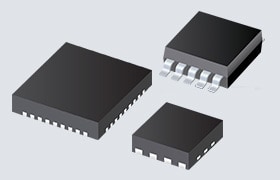
- Ultra-low profile lead-less plastic package (MSL-1, 260°C per IPC/JEDEC J-STD-20)
- Lead-free, Halogen-free, RoHS-compliant, Green device
Applications
- DP4T antenna routing/swapping for cellular mobile devices
- LTE and 5G applications
Specifications
- 38dBm to 39dBm maximum RF input power
- RFFE supply voltage ranges
- 1.1V to 1.3V for MIPI 1.2V bus
- 1.65V to 1.95V for MIPI 1.8V bus
- 15µs maximum power-up settling time, 7µs typical
- 2µs maximum switching time, 1.3µs typical
- 100MHz to 7.125GHz frequency range
- 1.1dB to 2.35dB insertion loss range
- -40°C to +85°C ambient temperature range
- -40°C to +125°C junction temperature range
- 3P3T, 4P4T, DPDT, and DP4T switch configurations
- ATSLP-10, PG-ULGA-16-6, ULGA-16-5, ULGA-16-6, and WLGA-18-1 package options
Block Diagram

MIPI Timing Diagram

Resource
Publicado: 2024-11-01
| Actualizado: 2024-11-11